



Latest updates on food labelling, claims and compliance
Australia's food and beverage regulatory landscape continues to evolve, with a number of significant developments affecting product labelling, advertising and compliance obligations. Recent reforms and regulatory priorities highlight the importance of ensuring claims are well substantiated, labels remain compliant and businesses are prepared for upcoming changes to food standards requirements.
Key takeaways
- Mandatory Health Star Ratings on the horizon: Food Standards Australia New Zealand (FSANZ) is consulting on proposals to make the HSR system mandatory for most packaged foods. The second round of consultation is planned to open in October. Businesses should consider the operational impact of mandatory HSR labelling on their product lines.
- ACCC focus on labelling claims: The Australian Competition and Consumer Commission is actively scrutinising claims on food and beverage labels and advertisements, including country of origin, health/nutrition, the word ‘natural’, and environmental claims. Businesses should review existing labels to ensure claims are substantiated and not misleading.
- New caffeine regulations: These commenced on 9 June 2026, with a 24-month transition period, introducing new labelling and composition requirements for high caffeine foods and beverages.
Health Star Ratings reforms
Reforms to make the Health Star Ratings (HSR) system mandatory are being considered following consensus by the Food Ministers (comprising responsible ministers from the Australian Government, New Zealand Government, and each Australian State and Territory).
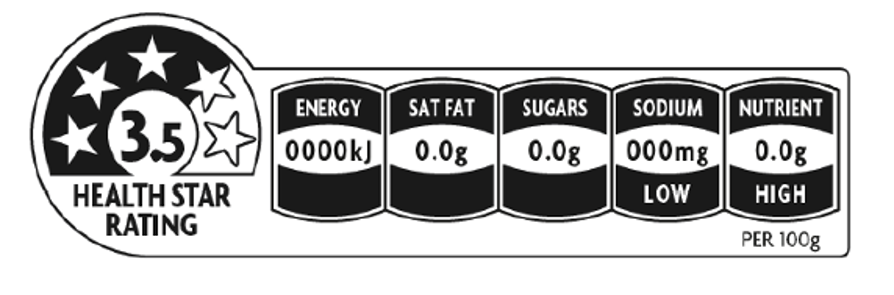
The HSR system was first implemented in 2014 and was intended to provide a simple and standardised way for consumers to compare the nutritional value of similar foods. The HSR was reviewed in 2016, 2019 and 2025. The move towards a mandatory HSR is driven largely by monitoring that showed uptake of the HSR fell well short of the 70% target by 2025.
FSANZ has been tasked with preparing the proposal for a mandatory HSR system. It released its initial proposal, P1067 – Health Star Rating System, for consultation between May and July this year.
The main proposed changes to the HSR are:
- requiring that foods do not vary in nutrient composition (ie, foods that are required to bear a NIP) to display the HSR star symbol on packaging. The symbol would be voluntary for foods that are not required to display a nutrition information panel (NIP); and for brewed soft drinks. Formulated meal replacements and formulated supplementary foods would be prohibited from including the HSR symbol on packaging. The existing 'nutrient icons' would not be permitted;
- with respect to foods containing multiple individually packaged servings, the outer pack may display an HSR symbol corresponding to the lowest HSR of all the foods within the package, or alternatively display each HSR symbol on the front of the package; and
- points for concentrated fruit, vegetable, nut and legume content (FVNL) would be removed, leaving only points and thresholds for non-concentrated FVNL.
Some changes are proposed to the category names and definitions, but these are not substantive and would not greatly alter the way the existing algorithm operates. Relevantly, FSANZ has decided against changes to the algorithm to account for the degree of processing of food, stating that the current Australian dietary guidelines do not address that aspect.
The method of calculation under the HSR is intended to be consistent with the Australian Dietary Guidelines, encouraging consumption of fruit, vegetables, grains, lean meats and dairy, and limiting intake of foods containing saturated fat, added salt and added sugars and alcohol.
The National Health and Medical Research Council is reviewing the Australian Dietary Guidelines (from 2013), and published draft new guidelines that are expected before the year's end. The consumption of ultra-processed foods and its relationship to comorbidities is an area directly within the NHMRC's scope of commission. If the proposed new dietary guidelines address ultra-processed foods, it may cause FSANZ to shift significantly on the existing HSR proposal.
Proposal 1067 for the most part, if implemented in its current-proposed form, would operate much like the existing voluntary HSR. One key issue that the FSANZ proposal does not address is how the mandatory HSR would improve clarity for consumers in their everyday food and beverage choices.
A second round of consultation is planned for October 2026.
ACCC microscope on claims
Food and beverage labels are firmly in the ACCC’s crosshairs. Following media reporting earlier this year about country of origin and supply chain claims, the ACCC has signalled a heightened focus on claims made on labelling, packaging and in advertisements for food and beverages.
The regulator recognises that claims about desirable traits can shape consumer purchasing decisions. Accordingly, it is focussed on ensuring that claims are fairly substantiated and do not misrepresent or over-represent the qualities of the goods.
What should businesses do? Given the renewed regulatory scrutiny, businesses should proactively review their existing labels to ensure all claims remain accurate, substantiated and defensible.
It is worth remembering that whether a claim breaches the Australian Consumer Law is assessed holistically, from the perspective of a reasonable consumer. The ACCC will look at the full picture: the surrounding imagery and claims on pack, the nature of the product, where and how it is sold, its price point, and the way the claim is presented.
The following types of claims can often present challenges for food and beverage businesses in terms of framing to the consumer in a manner which is succinct but also which does not cause confusion or misunderstanding in the mind of the consumer:
- claims relating to desirable or premium features or ingredients;
- claims about nutrition or health benefits (these could breach the FSANZ Code as well);
- country of origin claims for products that have been processed in different countries, or contain ingredients from different places (in particular 'Australian' claims or claims that lean into a geographical signification);
- absolute claims, because they leave little room for clarification or qualification (eg, 100%);
- 'natural' claims or claims that the food/beverage is free from an undesirable characteristic; and
- environmental claims (eg, carbon offset, recycling/recyclable, renewable energy claims).
Country of origin and sourcing claims often depend, at least in part, on representations from third party ingredient suppliers. Relying solely on a supplier’s word or representation may not be enough. Depending on the nature of the claim and the size and sophistication of the parties, a business may be expected to take reasonable steps to independently verify those representations.
Disclaimers can provide more information about a claim or qualify its scope. However, a disclaimer will not cure a misleading headline claim. Its wording, prominence and placement on a package are also relevant. For example, the ACCC considered a claim '100% ocean plastic' on yoghurt packaging to be misleading.
Businesses should also be aware that what is left off the label can be just as problematic. Omitting information that a reasonable consumer would need to avoid being misled can create a misleading impression.
In June, Doreen Eggs paid two infringement notices for labelling its eggs 'free range' when the the hens lacked access to an outside range, as required under the Free Range Egg Labelling Information Standard 2017.
Other regulatory updates
Caffeine regulations: Changes to the regulation of caffeine commenced on 9 June 2026. Businesses have 24 months to comply. The key changes include:
- retail sale of caffeine and guarana extract as a food is prohibited (coffee-lovers, fear not: this doesn't apply to naturally occurring caffeine in tea, coffee, cocoa or chocolate);
- packaged caffeinated beverages containing 200 milligrams or more caffeine per serving will need to declare the caffeine content per serving in the nutrition information panel and carry an advisory that the product is not suitable for children under 15 years old and pregnant or breastfeeding women; and
- formulated supplementary sports foods may include up to 200 milligrams of added caffeine in each individual serving. Those foods will need to include warning labels and disclose the caffeine content.
Added sugars in NIP: In March 2026, FSANZ abandoned its proposal that 'added sugars' be listed separately in the nutrition information panel. FSANZ concluded it had no clear public health benefit, would impose substantial costs on the industry and government, and could confuse consumers.
Seafood country of origin labelling: From 1 July 2026, hospitality businesses must display country of origin information for seafood, namely whether it is Australian (A), imported (I) or of mixed origin (M), in terms of where it was harvested.