



Care A2 Plus Pty Ltd v The a2 Milk Company Limited (No 2) [2026] FCA 475
On 23 April 2026, Justice Rofe of the Federal Court handed down Care A2 Plus Pty Ltd v The a2 Milk Company Limited (No 2) [2026] FCA 475 (Care A2 v a2 Milk). Her Honour held that Care A2 Plus Pty Ltd and its related entities (Care A2) infringed two registered trade marks of The a2 Milk Company Limited (a2 Milk) under section 120(1) of the Trade Marks Act 1995 (Cth) (TMA) and engaged in misleading or deceptive conduct and misrepresentation under sections 18 and 29 of the Australian Consumer Law (ACL). Care A2 also failed in its invalidity challenge to a2 Milk's registered trade marks.
a2 Milk won only because it had years of careful, extensive use behind it, plus expert evidence to prove 'a2' was a brand and not a protein descriptor. If your brand name points to an ingredient or scientific characteristic, expect to defend it, and expect that to be expensive.
Key takeaways
- Conduct due diligence before using scientific or industry terms as brands: Businesses should assess whether a term functions as established scientific terminology or as a competitor's trade mark before adopting it, as this can significantly affect infringement risk.
- Descriptive trade marks can be protected, but are harder and more expensive to enforce: Owners may need substantial evidence, such as consumer research, expert reports and consistent trade mark use, to prove the term functions as a brand rather than a descriptor.
- How a term is used and presented matters: Courts will distinguish between descriptive use (eg referring to an ingredient or product characteristic) and trade mark use. Clear use of ™/® symbols and correct scientific terminology can help support the intended position.
- Competitors can reduce infringement risk through careful branding: Integrating shared terms into a distinctive composite brand, rather than giving them standalone prominence, and ensuring descriptive references are clearly separated from branding can help avoid trade mark disputes.
- Monitor competitor use of your brand: Businesses that use a brand derived from scientific terminology should monitor the use of the term by competitors and take enforcement action as necessary to ensure that the brand does not become generic through common descriptive usage in the market.
a2 Milk
a2 Milk was founded by Dr Corran McLachlan and Howard Paterson, who had discovered that cows could be genetically tested to identify those producing milk free of the A1 β-casein protein, milk that purportedly offered benefits such as digestive wellbeing, improved taste and superior frothing ability.
a2 Milk's registered trade marks
a2 Milk is the registered owner of the following five trade marks covering milk and infant milk powder in Australia (collectively, a2 Milk Marks), among many others:
| Trade mark | Number | Class | Priority date |
|---|---|---|---|
| a2 Milk | 1708342 | 5 and 29 | 20 July 2015 |
 |
1676054 | 5 and 29 | 20 February 2015 |
 |
1668754 | 5 and 29 | 13 January 2015 |
 |
1454858 | 5 and 29 | 20 October 2011 |
 |
1422098 | 5 and 29 | 23 March 2011 |
a2 Milk's evidence of use
a2 Milk had strong evidence of the continuous and extensive use of the a2 Milk Marks in Australia since at least 2003. Key evidence showed that a2 Milk:
- always used the a2 Milk Marks with 'a2' where 'a' is in lowercase;
- always used the a2 Milk Marks on product packaging with the ™ or ® symbol, as appropriate;
- used 'a2' in all consumer marketing activities in Australia;
- sold its products under the a2 Milk Marks at a significant price premium over regular dairy products;
- sold its products under the a2 Milk Marks in Australia at more than 2,500 supermarkets and 450 pharmacies in March 2024;
- was the only milk brand distributed through all six key grocery retailers in Australia (Woolworths, Coles, Aldi, Costco, Metcash (IGA) and SPAR) in October/November 2020;
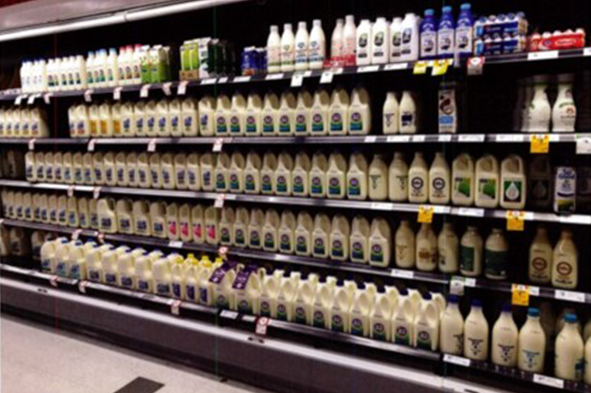
- displayed its products under the a2 Milk Marks at supermarkets in a 'brand block', as shown below;
- generated sales under the a2 Milk Marks in Australia and New Zealand of many hundreds of millions of dollars in 2019 and 2020;
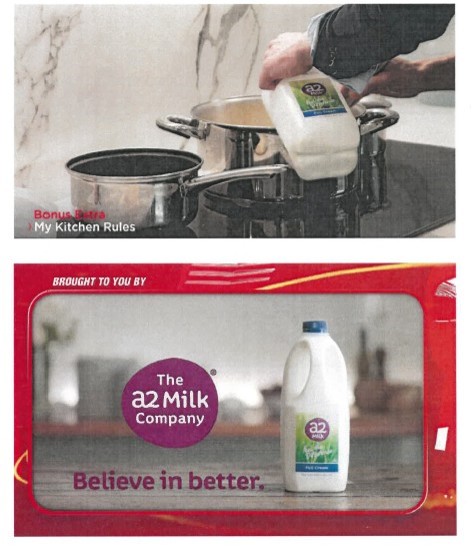
- incurred advertising expenditure for the a2 Milk Marks in Australia of many millions of dollars, which included ads on social media, billboards, television and radio, on video-on-demand and YouTube, and sponsorship of top-rating television programs such as MasterChef Australia, My Kitchen Rules, The Block and LEGO Masters;
- had market share for fresh milk of 10.5% in 2018-2019 and 8.7% in 2019-2020 and for infant formula of 36.8% in 2018-2019 and 20.4% in 2019-2020; and
- had conducted annual surveys, Brand Health Reports, since 2010, which consisted of thousands of 15-minute online interviews with grocery buyers aged 18 and over, and the report, a2 MILK™ Brand Health: Wave 11, December 2020, concluded that the 'a2 Milk' brand is a highly recognised and trustworthy brand, with over 8 in 10 people recognising the brand.
Care A2
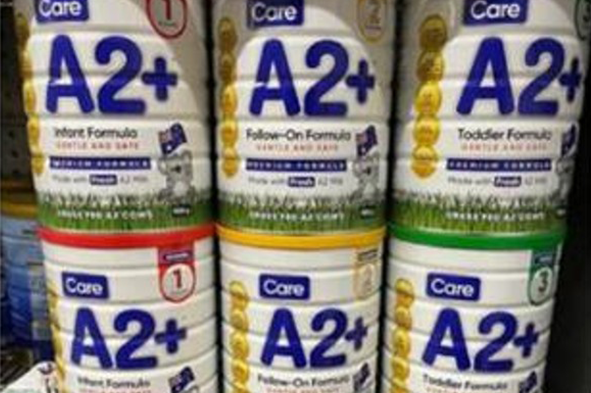
Since at least November 2020, Care A2 has manufactured and sold infant and toddler formula in Australia in packaging that included the signs 'A2', 'A2+', 'Care A2+', 'AUSTRALIAN A2 MILK', 'GRASS FED A2 COWS', 'Made with Fresh A2 Milk' and 'Made with Fresh Australian A2 Milk'.
Care A2 advertised and promoted its products on its websites at <carea2plus.com> and <thecareclub.store>, in its investor bulletin, and by sponsoring a tennis tournament known as the 'Care A2+ Kooyong Classic' and associated merchandise.

Care IP Pty Ltd, a related entity, is the applicant for ten trade marks that include the word element 'A2+' in Australia.
Key findings
The central issue was whether 'a2/A2' functions as a brand or a scientific descriptor. a2 Milk had no objection to third parties using 'A2' to describe the A2 β-casein protein present in milk, but argued Care A2's use of 'A2' went beyond descriptive use. a2 Milk brought proceedings against Care A2 for trade mark infringement under section 120(1) of the TMA and for misleading or deceptive conduct and misrepresentation under sections 18 and 29 of the ACL. Care A2 brought an invalidity proceeding to cancel, rectify or limit the a2 Milk Marks under section 88 of the TMA. Care A2 was unsuccessful, and a2 Milk was successful, for the reasons summarised below.
Care A2's invalidity proceeding
Care A2 sought to cancel or limit the a2 Milk Marks or to otherwise have them rectified by entering an endorsement that 'registration does not confer any exclusive right to the use of the terms "A2", "A2 Milk", "a2", or "a2 Milk"'.
Care A2 pressed six grounds of invalidity under sections 41, 42(b), 43, 59, 24 and 25 of the TMA. The most significant was the challenge to distinctiveness under section 41. Justice Rofe rejected each of the remaining grounds, principally because Care A2 led no evidence in support and because the reasoning on descriptiveness disposed of them. The section 41 challenge is summarised below.
(a) Distinctiveness (section 41 of the TMA)
Care A2 pleaded that the a2 Milk Marks were not capable of distinguishing milk and milk products because 'a2/A2' and 'a2 milk/A2 milk' describe that the products contain only, or predominantly, the A2 β-casein protein. (Care A2 tried to add to its pleading that this also meant the absence of the A1 β-casein protein but Justice Rofe rejected its attempt.)
In addition to evidence of its use, a2 Milk filed evidence of:
- its chief scientific advisor, which provided that it was the absence of certain β-casein protein variants which provide purported health benefits in milk;
- Professor Quester, a consumer behaviour and marketing expert, which provided that prior to a2 Milk's launch in 2003, consumers had no familiarity with the meaning of 'a2' or milk protein nomenclature; and
- Professor Zuckermann, a linguistic and lexicographic expert, which provided that common Australian English lexical mechanisms (eg, '-free', 'non', 'no') meant a trader would likely use terms such as 'A1-free', 'A1 beta-casein protein-free' or 'zero A1' to describe milk free from A1 β-casein protein, rather than 'a2/A2'.
Care A2's sole evidence in the proceedings was the affidavit of its solicitor annexing about 300 pages of documents obtained primarily through Google searches by six employees. Justice Rofe did not consider that evidence to be persuasive because it included documents that referred to a2 Milk's own products, showed explanations rather than an understanding of 'a2/A2', or were from New Zealand websites, scientific journals, patent specifications or the Macquarie Dictionary (the definition of 'a2' contained in which was challenged by Professor Zuckermann). Justice Rofe also did not consider any of a2 Milk's own uses of its trade marks to be descriptive.
Agreeing with Justice Bromwich who held that 'a2/A2' and 'TRUE A2' were sufficiently inherently adapted to distinguish in The a2 Milk Company Ltd v LD&D Australia Pty Ltd (2021) 164 IPR 293 (LD&D), Justice Rofe held:
- 'a2/A2' did not ordinarily signify milk or milk products free from A1 β-casein protein. 'a2 milk'/'A2 milk' is not a scientific or descriptive term for A1 β-casein protein-free milk and is allusive at most. The relevant consumer being the general public would not have any knowledge of milk protein chemistry;
- other traders were more likely to use the alternative terms set out in Professor Zuckermann's evidence (eg, 'A1-free', 'A1 beta-casein protein-free' or 'zero A1'); and
- the a2 Milk Marks had otherwise acquired distinctiveness through use.
Fundamentally, a trade mark must operate as a badge of origin to distinguish the goods or services provided by one trader from those of others. Some words so directly describe the product or a characteristic of the product they can never be registered (e.g. “fresh fruit”). At the other end of the spectrum, if a trade mark is invented, it is inherently adapted to distinguish because it has no meaning at all (e.g. ZESPRI, VIENNETTA).
As explained by the High Court in Cantarella Bros Pty Ltd v Modena Trading Pty Ltd [2014] HCA 48; (2014) 254 CLR 337 at [59] words that make a covert or skilful allusion to, but do not directly describe, a product or characteristic are prima facie registrable. This is also true of trade marks derived from a scientific term or ingredient name.
In the case of “a2 Milk”, “a2/A2” operates as a trade mark because it merely alludes to the absence of A1-type beta-casein proteins in the milk sold under the trade mark. By contrast, the term “A1-free” is not a trade mark in the same way that “fat free” or “lactose free” are not trade marks, because they directly describe a particular characteristic of the milk. Further, the expert linguistic and marketing evidence in that case established that the sign “A2” lacked an ordinary signification or meaning to consumers in Australia when it was first used in 2003, but in any event would have come to distinguish the goods of one trader through extensive use since that time.
Even if a trade mark is not inherently adapted to distinguish, it can still be registered if there is evidence that the mark has already or will come to distinguish through (generally) extensive use. This is known as acquired distinctiveness. Examples of such trade marks registered in Australia include WHOPPER (for burgers and restaurant services), MINTIES (for mints) and ESTABLISHMENT (for restaurant services). Importantly, the evidence must show use of the mark as a trade mark, not general or descriptive use.
- Sonia Stewart, counsel for a2 Milk
a2 Milk's infringement proceeding
Justice Rofe held that Care A2's conduct infringed the a2 Milk Marks under section 120(1) of the TMA. However, the infringement finding was notably limited in scope, reflecting the constraints inherent in a2 Milk’s portfolio of marks built around a descriptive term.
As a threshold matter, it is important to note that a2 Milk’s strongest mark that it could rely on in this case was the word mark ‘a2 Milk’ (TM 1708342), and not a mark for 'A2' or 'a2' only, which only proceeded to registration after Justice Bromwich’s decision in LD&D. The remaining four marks are device marks incorporating stylised elements and specific get-up.
Composite mark or two separate trade marks? The critical preliminary issue was how Care A2’s sign should be characterised. Care A2 argued that consumers would perceive the composite phrase ‘Care A2+’ as a single badge of origin, with the distinctive word ‘Care’ differentiating it from a2 Milk’s marks. a2 Milk argued that ‘Care’ and ‘A2+’ functioned as two separate marks.
Justice Rofe found that Care A2 was using two separate marks: ‘Care’ and ‘A2+’. Her Honour was influenced by the significant differences in font, style, size and placement of the two components: ‘A2+’ was always prominently and centrally displayed in large, bold, dark blue capital letters with silver bevelling, whereas ‘Care’ appeared in a much smaller separate blue lozenge that was often partially obscured by price tickets on retail shelves. The positioning of ‘Care’ relative to ‘A2+’ was not fixed. It appeared above, beside and in varying sizes across different materials, further supporting the impression that the two elements operated independently.
Deceptive similarity limited to only two marks. On the basis that ‘A2+’ was a standalone sign, Her Honour held that it was deceptively similar to (though not substantially identical with) only two of the five a2 Milk Marks: the word mark ‘a2 Milk’ (TM 1708342) and the simpler ‘a2’ device mark (TM 1676054). Critically, ‘A2+’ was not found to be deceptively similar to the remaining three device marks (TMs 1668754, 1454858 and 1422098), which incorporated more elaborate stylised elements and get-up. This means that the older, more heavily stylised registrations – the very marks a2 Milk was able to obtain without the same descriptiveness battles – provided no enforcement utility in this case.
No infringement if ‘Care A2+’ is one composite mark. In the alternative, Her Honour considered the position if ‘Care A2+’ were viewed as a single composite mark. On that characterisation, she held that ‘Care A2+’ was not deceptively similar to any of the a2 Milk Marks. This is a significant finding. It means that if Care A2 had more effectively locked ‘A2’ together with its house mark ‘Care’ – for example, by using consistent sizing, integrated presentation and fixed positioning – the infringement case would likely have failed entirely. The practical implication is that a third party can potentially design around a2 Milk’s registrations by combining ‘A2’ with a sufficiently distinctive house brand in a manner that consumers perceive as a single composite sign.
Justice Rofe awarded additional damages on the basis that the infringement was flagrant. Care A2 had continued its conduct after receiving a letter of demand and had originally challenged around 50 of a2 Milk’s trade marks before failing to pay security for costs, resulting in the narrowing of its case to the five marks in suit.
a2 Milk's ACL proceeding
Justice Rofe held that Care A2's conduct also constituted misleading or deceptive conduct and misrepresentation under sections 18 and 29 of the ACL. Her Honour found that, taking into account all immediate and broader context, the relevant consumer would likely perceive the prominent 'A2/A2+' on the tins or sponsorship materials as indicating a connection with a2 Milk. Consumers would be confused, misled or deceived into thinking that the product and event were provided by, or had the licence, approval or authorisation of, a2 Milk. It was also relevant that Care A2 had no evidence explaining why it adopted the 'Care A2+' sign, or whether any due diligence was conducted, and that a2 Milk filed evidence of actual confusion where a National Business Review (NBR) article about a2 Milk wrongly included Care A2+ product images, although little weight was given to that evidence alone.