


The latest issues, decisions and proposed changes impacting business and workplace risk
On This Page
- Understanding the FWC's road transport contractual chain order for fuel cost recovery
- New guidance on NSW long service leave legislation released
- Regulating respect: three years of the Sex Discrimination Act positive duty
- A rise in reinstatement
- Victorian Government's move to introduce legislative right to work from home
Understanding the FWC's road transport contractual chain order for fuel cost recovery
By Chloe Wilton and Sophie Baxter
Is your business in a road transport contractual chain?
The Road Transport Contractual Chain Order – Fuel Cost Recovery – 2026 (the Order) recently took effect. Its purpose is to ensure parties at the top of a road transport contractual chain bear any increased fuel cost arising out of the ongoing conflict in the Middle East, and the regulated road transport contractors or employee-like workers at the bottom of the chain are wholly compensated for that increased cost. We explain what businesses need to be doing now to meet their obligations.
Key Takeaways
- The Order—which the Fair Work Commission (the FWC) issued on 20 April 2026—is broad, and could potentially cover all businesses that directly or indirectly pay for work in the road transport industry.
- It requires businesses that are covered by it to proactively adjust rates to account for the increased cost of fuel, regardless of whether other parties in the chain request an increase. The Order took effect on 21 April 2026, and the obligations under it apply to any increased costs from that date onwards. The first rate adjustment needed to have been made by 5 May 2026.
- Businesses should act promptly to:
- identify all arrangements that may involve work in the road transport industry;
- seek information from other parties in the chain to determine whether the business is covered by the Order, whether the business is required to adjust rates to account for the increased cost of fuel (and if so, by how much), and what other parties in the chain are doing to ensure any increases are passed down the chain;
- determine whether existing arrangements already provide for rates to be adjusted each fortnight or twice monthly to reflect the full increased cost of fuel as the Order requires and, if not, put in place systems and processes to do so; and
- seek legal advice if it is not clear whether the business is covered by the Order.
- The obligations under the Order will cease to apply if the weekly average national price of diesel falls below $2 per litre.
Key concepts
What is a road transport contractual chain?
A road transport contractual chain is a chain or series of contracts or arrangements under which work is performed for a party to the first contract or arrangement in the chain or series by a regulated road transport contractor or a road transport employee-like worker under a services contract, or an employee. At least one party to the first contract or arrangement in the chain or series must be a constitutional corporation.
Who are the parties to a road transport contractual chain?
A road transport contractual chain consists of:
- primary parties: the parties to the first contract or arrangement in the road transport contractual chain;
- secondary parties: the parties to any subsequent contract or arrangement in the chain, being a contract or arrangement under which work is performed for the secondary party by a regulated road transport contractor or a road transport employee-like worker under a services contract, or by an employee; and
- regulated road transport contractors or road transport employee-like workers who perform work for a secondary party under a services contract in the chain. In summary:
- A regulated road transport contractor is an individual who performs the significant majority of the work in the road transport industry under the relevant services contract and who is not an employee. The individual need not be a party to the services contract (eg the individual can contract through a corporate entity).
- A road transport employee-like worker is similar to a regulated road transport contractor but the work they perform is arranged or facilitated through a digital platform.
In some situations, it will be relatively straightforward to determine who are the parties to a road transport contractual chain. For example, a simple road transport contractual chain may look like this:
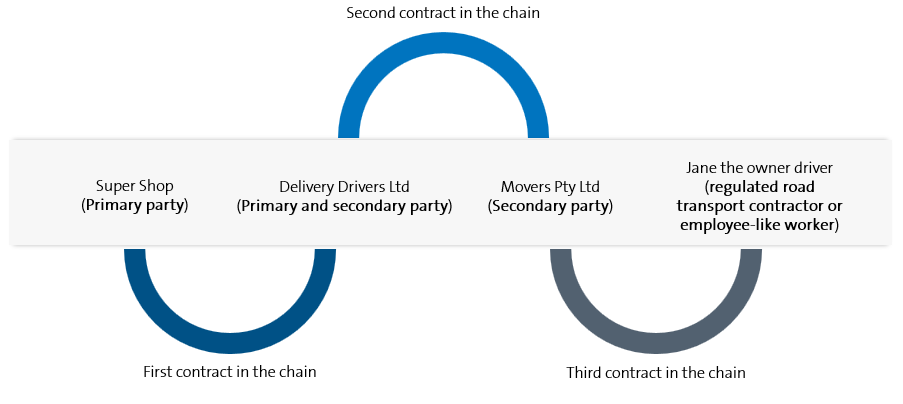
In this example, Super Shop has engaged Delivery Drivers Ltd to perform road transport services, and so it is clear that Super Shop and Delivery Drivers Ltd are primary parties to the first contract in the chain, and Delivery Drivers Ltd and Movers Pty Ltd are secondary parties to subsequent contracts in the chain.
However, in some situations it may be unclear who the parties to a road transport contractual chain are.
What is the road transport industry?
The road transport industry includes:
- the road transport and distribution industry, including the transport by road, receiving, handling, storage and distribution of goods, wares, merchandise, material and livestock (including long-distance operations);
- the waste management industry, which includes the collection, transportation, handling, recycling and disposal of waste material, and the operation of waste facilities; and
- the passenger vehicle transportation industry.
The cash-in-transit industry is not part of the road transport industry for the Order's purposes.
Obligations
The relevant obligations arising under the Order for each type of party are set out below.
| Party | Obligation |
|---|---|
| Primary parties |
Adjust the rate paid to the other primary party for work in the road transport industry, to cover the increased cost of fuel Within each fortnight (ie this was by 5 May 2026 for the first adjustment) or twice per calendar month, adjust the rate paid to any other primary party for the performance of work in the road transport industry by the amount necessary to ensure that the other primary party recovers the increased cost of fuel from 21 April 2026. To comply with this obligation, primary parties will require information from other parties in the chain, including regarding what the increased cost of fuel is for the relevant work in the road transport industry. |
|
Primary parties (excluding small business employers that are not road transport businesses) |
Take reasonable steps to ensure secondary parties pass on the cost adjustment Take reasonable steps to ensure that secondary parties engaging regulated road transport contractors or road transport employee-like workers in the same road transport contractual chain adjust the rate they pay to such regulated road transport contractors or road transport employee-like workers for the performance of work in the road transport industry by the amount necessary to ensure recovery of the increased cost of fuel from 21 April 2026. |
| Secondary parties |
Adjust the rate paid to any other secondary party, regulated road transport contractor or road transport employee-like worker for work in the road transport industry, to cover the increased cost of fuel Within each fortnight (ie by 5 May 2026 for the first adjustment) or twice per calendar month, adjust the rate they pay to any other secondary party, regulated road transport contractor or road transport employee-like worker for the performance of work in the road transport industry by the amount necessary to ensure that the other secondary party, regulated road transport contractor or road transport employee-like worker recovers the increased cost of fuel from 21 April 2026. To comply with this obligation, secondary parties will require information from other parties in the chain, including regarding what the increased cost of fuel is for the relevant work in the road transport industry. |
What is the increased cost of fuel?
Increased cost of fuel means the difference between the cost per litre for the type of fuel used to perform the relevant work in the road transport industry at any given time, and the cost as it was on or before 6 March 2026.
How are rate adjustments to be made?
Rate adjustments may be made by:
- an adjustment to the rate or a component of the rate;
- the introduction of a fuel increment or levy;
- a direct reimbursement or offset of money expended upon the increased cost of fuel; or
- a combination of the above.
Rate adjustments made in accordance with another arrangement or agreement, including those implemented before 21 April 2026, may satisfy all or part of the rate adjustments that the Order requires.
What can happen if businesses don't comply?
Failure to comply with the Order would constitute a contravention of the Fair Work Act 2009 (Cth), for which a court may impose a pecuniary penalty on a corporation of up to $99,000 per contravention.
Dispute settlement
If there is a dispute regarding the Order's implementation or operation:
- the parties to the dispute must first genuinely try to resolve the dispute between themselves;
- if the dispute is unable to be resolved between the parties, a party may refer the dispute to the FWC;
- the FWC will attempt to resolve the dispute other than by arbitration, eg by conciliation; and
- if the dispute is not resolved, the FWC may arbitrate the dispute, only with the parties' consent.
Next steps for businesses
It is important for all businesses to:
- identify all arrangements that may directly or indirectly involve work in the road transport industry; and
- determine whether the business is a primary or secondary party to a road transport contractual chain regarding any such work.
If your business is in a road transport contractual chain, you should seek information from other parties in the chain to determine:
- if you are required to adjust rates to account for the increased cost of fuel, and if so, by how much; and
- what other parties in the chain are doing to adjust ensure any increases are passed down the chain.
If your business is required to adjust rates to account for the increased cost of fuel:
- consider whether your existing arrangements already provide for this (noting that they may not provide for full recovery of the increased cost of fuel compared with the cost on or before 6 March 2026, as the Order requires), and if not, put in place systems and processes to adjust rates each fortnight; and
- if you are a primary party, consider what steps you will take to ensure the increase is passed down the chain.
If it is unclear whether your business is in a road transport contractual chain, we recommend that you seek legal advice as soon as practicable, to assess your options.
New guidance on NSW long service leave legislation released
By Tarsha Gavin, Eden Sweeney and Jaden Ametson
New guidance provides clarification on entitlements
The NSW Industrial Relations division of the Premier's Department (the NSWIR)—the department responsible for enforcing NSW's long service leave (LSL) legislation—has released new guidance for employers regarding their obligations under the Long Service Leave Act 1955 (NSW) (the Act).
Key takeaways
- The New South Wales Long Service Leave Guide (the New Guidance), released in March, outlines the NSWIR's preferred interpretation of the Act on a range of issues, including calculating continuous service, determining an employee's LSL entitlement, calculating LSL payments for different cohorts of employees, and issues such as when bonus payments should be included in calculations.
- While some aspects of the guidance appear to depart from previous published guidance, other parts provide a greater level of detail on the Act's interpretation and application. Employers may need to check how their LSL entitlements for NSW employees are currently being calculated, and whether any changes are needed to comply with the New Guidance.
- NSWIR has indicated that enforcement will not be used as a primary tool in the first six months of the New Guidance's operation as employers assess their current compliance.
Key matters covered in the New Guidance
The key areas where NSWIR has provided new or different guidance include:
- Change in classification for employees with more than one source of remuneration For the calculation of LSL payments, the New Guidance now recognises an expanded definition of 'workers remunerated otherwise than wholly in relation to an ordinary time rate of pay', beyond the previous definition of commission-only workers and pieceworkers, which now includes any employee that has more than one source of remuneration. For example, this may capture casual employees with more than one rate of pay (such as those sometimes paid higher duties), or permanent salaried employees entitled to a bonus at the prescribed date.
- 'Stringing together' engagements for casual employees The New Guidance sets out a new approach to identifying continuous service for casual employees, requiring employers to consider the pattern of work that a casual employee engages in. This pattern will comprise working days and regular breaks between those days, and will be broken where there are interruptions to that pattern. An employer will need to assess abnormal breaks by understanding the reason for their occurrence to determine if they break the pattern of work, and, thus, potentially break the casual employee's continuous service or not count towards their period of service in accordance with the Act.
- Change to pro-rata LSL entitlements for employees with more than 15 years of service The New Guidance now recognises that employees are entitled to a proportionate amount of LSL for service completed beyond a 15-year milestone period (ie all service counts after 15 years, not just for completed years beyond a milestone period). For example, under previous guidance, an employee with 18 years and seven months of service would only have had an entitlement to 18 years of LSL. The New Guidance indicates that they are entitled to the full 18 years and seven months.
- Clarification on when employees with between five to 10 years of service are entitled to pro-rata LSL entitlements The New Guidance has also provided clarity on the meaning of resigning due to 'domestic or other pressing necessity', which was previously undefined in the guidance, and remains undefined in the Act. While each employee's situation is fact dependent, the New Guidance suggests that 'domestic or other pressing necessity' may arise where an employee resigns due to a need to move away from the place of work in order to care for a sick family member; needs to relocate to maintain a spousal relationship; there are insufficient wages to meet essential family financial commitments; or because of concerns about job security, such as when there is an impending restructure.
- Assessing bonuses and incentives The New Guidance sets out NSWIR's view on the approach to whether a bonus or incentive needs to be included in LSL calculations, now specifying four requirements a payment must meet. It must:
- be provided for under the terms of the worker's employment;
- be part of an established bonus or incentive scheme;
- be dependent on results or performance, and not solely hours worked; and
- not be the worker's main form of remuneration.
Regulating respect: three years of the Sex Discrimination Act positive duty
By Anthony Hallal and Laney Facchinetti
Taking stock of the positive duty and the AHRC's powers
Since 2022, employers and persons conducting a business or undertaking have had a positive duty under the Sex Discrimination Act 1984 (Cth) (the SDA) to take reasonable and proportionate measures to eliminate as far as possible certain types of proscribed conduct, including unlawful sex discrimination, sexual harassment and related types of conduct. Since 2023, the Australian Human Rights Commission (the AHRC) has had regulatory functions relating to the positive duty under the SDA. We explain the impacts so far of these reforms, and what may lie ahead.
Key takeaways
- The positive duty has now been operative for over three years, and the AHRC's regulatory functions have been in place for over two years. The AHRC's powers include conducting inquiries into compliance with the positive duty, issuing compliance notices, applying for court orders to direct compliance with a compliance notice and entering into enforceable undertakings.
- It is possible that enforcement action relating to the positive duty may increase in the coming years, as we move out of the positive duty's introductory phase and stakeholder expectations mature.
Update on the regulatory approach
The AHRC recently published an update on its promotion of the positive duty, covering its focus on higher-risk industries such as retail and hospitality, and its inquiries and monitoring of employers.
The AHRC reportedly has active inquiries into four businesses' compliance with the positive duty, and is seeking information from eight large retailers about their compliance. These ongoing inquiries relate to a hospitality business, a financial services provider, a transport and logistics company, and an entertainment retailer. The AHRC's activities in this space have also included collaboration with health and safety regulators, and developing educational resources and training to build awareness and capability.
While the AHRC's approach has largely focused on supporting businesses to comply, an independent review of the positive duty and the AHRC's functions is scheduled for 2026–2027.1 This may result in a shift in compliance and enforcement activities.
Key lessons for employers
The AHRC's Guidelines for Complying with the Positive Duty sets out four Guiding Principles and seven Standards that are intended to guide businesses on what the AHRC expects them to do in order to discharge their positive duty under the SDA. These requirements and guidelines form one part of Australia's broader regulation of respect and equality in the workplace. (For an analysis of another aspect, the Workplace Gender Equality Act 2012, see our Insight.)
In combination with businesses' own public-facing commitments to internationally recognised human rights principles, including those under the UN Guiding Principles on Business and Human Rights (the UNGPs), these requirements and guidelines prompt businesses to take proactive action to prevent discrimination, harassment and other harm from occurring. In order to do so, employers should consider:
- whether senior leaders understand their obligations under the SDA, and their responsibility for ensuring that appropriate measures for preventing and responding to relevant unlawful conduct are developed, recorded in writing, communicated to workers, implemented and have their effectiveness assessed;
- whether steps have been taken to foster a culture that is safe, respectful, inclusive and diverse;
- how their commitments and expectations relating to respectful workplace behaviour are distilled in policies, and how those policies are implemented, including through an underlying program of work that is aimed at managing risk, and supporting workers who experience or witness conduct that contravenes Respect at Work standards;
- whether they have designed and implemented effective grievance mechanisms that provide culturally safe and gender-sensitive options for reporting and responding to unlawful conduct, which are aligned with the effectiveness criteria in Principle 31 of the UNGPs (to which employers may have committed); and
- how data is gathered and monitored to assess and improve a workplace culture that is geared towards preventing and responding to relevant unlawful conduct.
A rise in reinstatement
By Chloe Wilton and Sayomi Ariyawansa
The FWC reinforces reinstatement as the primary remedy for unfair dismissal
Over the past 18 months, the Fair Work Commission (the FWC) has reinforced that reinstatement is the primary remedy for unfair dismissal. Historically, if the FWC determined that an employee had been unfairly dismissed, it rarely ordered reinstatement—eg because of an alleged breakdown of trust and confidence in the employment relationship. This is no longer the case.
Key takeaways
- The FWC has indicated that it will take a forward-looking approach to determining whether reinstatement is appropriate in the circumstances, even in the case of substantiated misconduct. If it is satisfied that there is a low likelihood of such misconduct occurring again, it is more likely to order reinstatement.
- Employers must lead specific and detailed evidence to demonstrate why reinstatement is inappropriate in the circumstances, focusing on the employee's ability to perform their role and comply with their obligations moving forward.
- Employers cannot rely on any presumption that the relationship of trust and confidence between the parties is necessarily and fatally compromised by the dismissal process and participation in adversarial proceedings.
Where reinstatement has been considered appropriate
The FWC has ordered reinstatement in the following circumstances:
- Insufficient evidence from the employer Where an employer asserts that reinstatement is inappropriate, they must prove to the FWC that this is the case. In Zheng v Guardian Community Early Learning Centre,2 the employer submitted that reinstatement was inappropriate due to a breakdown of trust and confidence, but did not lead any evidence to support that assertion. The FWC determined that there was no sound basis for any claim of lost trust and confidence, and ordered that the employee be reinstated.
- Breakdown in relationship with other employees The FWC has previously accepted that reinstatement was inappropriate due to the deleterious impact of adversarial proceedings, and of the events leading to the dismissal of an employee, on the relationship between the employee and their colleagues. However, in Mouat v OS MCAP Pty Ltd,3 it rejected the employer's argument that reinstatement would be inappropriate in circumstances where the employee made numerous allegations against the employer and other managerial employees in the course of the unfair dismissal proceeding, and during the investigation that preceded his dismissal. The FWC held that this was a feature of adversarial litigation, and not a bar to ordering reinstatement in that case.
- Non-compliance with employer's policies Even where the FWC has found that an employee has breached their employer's policies, it has ordered reinstatement where the employee did not demonstrate an unwillingness or inability to comply with the employer's policies in the future. In Barber v Veolia Recycling4 and DP World Sydney v Witherden,5 the employees were dismissed for single breaches of the employer's drug and alcohol policy. In both cases, the FWC ordered reinstatement, taking into account that the employees expressed contrition and an intention to comply with the relevant policies in the future.
Where reinstatement has been considered inappropriate
The FWC has found that reinstatement was inappropriate in more limited circumstances:
- Dishonest conduct by employee Where an employee has engaged in dishonest conduct and/or demonstrates a lack of judgment, the FWC may find that reinstatement is inappropriate. In Paramjit Brownson v Australian International Islamic College,6 it accepted that the employee's dishonesty during the investigation process, lack of judgment in deliberately keeping confidential student information to support her unfair dismissal case, and reluctance to attend an in-person meeting following her dismissal, demonstrated the extent of the breakdown of the employment relationship, which made reinstatement inappropriate.
- Lack of capacity and capability to perform the role Where an employee has demonstrated a lack of capacity and capability to perform their role, the FWC may find that reinstatement is not appropriate, as was the case in Andrew Murphy v Xavier College.7 In this case, it accepted that reinstatement was inappropriate, based on the employee's continued failures to provide students with timely feedback, maintain his workspace to an acceptable standard, and meet accountability requirements and respond to directions, which demonstrated a continued lack of capability and capacity to perform his role.
Victorian Government's move to introduce legislative right to work from home
By Sarah Lunny and Ally Gardiner
Right to work from home to apply to all employers, regardless of headcount
The Victorian Government has provided further details about its proposed work from home legislation, which, if passed, could come into effect as early as September 2026.
Key takeaways
- The Victorian Government intends to introduce legislation in July 2026 to introduce a right for employees who can reasonably do their job from home to be able to do so at least two days a week. If passed, the legislation will come into effect on 1 September 2026.
- The proposed laws will apply to all private and public sector employees, including those employed by small businesses.
Key features of the Victorian work from home proposal
In August 2025, Premier Jacinta Allan announced the Government's intention to introduce legislation providing for employees who could reasonably do their jobs from home to have a right to do so for at least two days a week. Since then, the Government has undertaken a consultation process, including conducting a large-scale survey of Victorian employees and businesses about the proposed rights under the legislation.
Although the Government has not yet released an exposure draft of the proposed work from home legislation, it indicated in March 2026 that:
- It plans to introduce the right by amending the Equal Opportunity Act 2010 (Vic), which currently protects Victorian employees against discrimination in employment on the basis of certain protected attributes.
- The new laws will include dispute resolution and enforcement mechanisms, including that disputes about the right will be referred to the Victorian Equal Opportunity and Human Rights Commission for conciliation (and if conciliation fails, could be heard by the Victorian Civil and Administrative Tribunal).
It is not clear what method the legislation will provide for determining whether an employee can 'reasonably do their job from home'.
It is also not clear whether the proposed legislation will be subject to constitutional challenge, noting that Victoria has referred most of its industrial relations powers to the Commonwealth (although matters dealt with in the Equal Opportunity Act are excluded from that referral).
Although the Fair Work Act 2009 (Cth) (the FW Act) contains provisions dealing with flexible working arrangements, there is no general right to request to work from home, and employees can only make a request for flexible working arrangements where they satisfy certain eligibility requirements. (For more information about the Greens' proposal to amend the FW Act to introduce a right to work from home, see our Insight.)
What's next?
The Government intends to introduce the legislation in July 2026. If passed, it has stated that the laws will commence on 1 September 2026, with commencement for workplaces with fewer than 15 employees deferred until 1 July 2027.
Footnotes
-
Australian Human Rights Commission (2025), Corporate Plan 2025-2026, p. 6.
-
[2025] FWC 3202.
-
[2025] FWC 3941 [55].
-
[2025] FWCFB 141.
-
[2025] FWCFB 133. See also Lee Witherden v DP World Sydney Limited [2025] FWC 294.
-
[2025] FWC 1551.
-
[2025] FWC 1284.